Services: Medical Equipment & Technology Infrastructure Planning
Medical Equipment & Technology Infrastructure Planning
Harmonizing Clinical Equipment, Low-Voltage Technology, and Architectural Space
Modern healthcare and medical education facilities are intricate ecosystems where clinical efficacy hinges on spatial and technological precision. When medical equipment procurement is isolated from low-voltage cabling, audiovisual capture, telecommunications, and acoustic design, the result is predictable: delayed schedules, unexpected change orders, and compromised clinical workflows.
At Convergent Technologies Design Group, we eliminate these friction points. By combining medical equipment spatial integration with core low-voltage systems design, our cross-trained designers provide a single point of technical accountability from schematic design through commissioning. We bridge the crucial gap between complex clinical hardware, building infrastructure, and architectural layout—ensuring every piece of diagnostic, surgical, and educational equipment functions flawlessly within its physical and digital environment.
Tailored Integration Strategies for Healthcare Stakeholders.
Achieving seamless technology integration requires aligning three distinct perspectives: architectural precision, financial stewardship, and clinical performance. Our unified approach provides tailored solutions for every project partner.
For Architects & Healthcare Design Teams: Zero-Clash Spatial Coordination
Architectural elegance must coexist with stringent clinical clearances and mechanical requirements. Convergent Technologies Design Group serves as a seamless extension of your design team.
Integrated BIM/Revit Modeling: We build fully coordinated 3D models incorporating equipment footprints, structural backing, conduit pathways, power drop locations, and low-voltage connections.
Single-Point Communication: Rather than managing separate consultants for AV, telecom, security, acoustics, and equipment placement, you work with one cross-trained project manager throughout all design phases.
Proactive Code & Clearance Verification: We verify headwall layouts, ADA access pathways, and manufacturer clearance envelopes long before construction documents are finalized.
For Hospital Executives & Capital Project Directors: Risk Mitigation & Capex Control
Unforeseen spatial conflicts during clinical equipment installation represent one of the primary drivers of healthcare construction cost overruns. Our team protects your capital investment.
Elimination of Sub-Consultant Scope Gaps: Dual-sourcing equipment layout and low-voltage design frequently leaves unassigned infrastructure scope. Convergent’s single-source design model ensures total coverage.
Change Order Prevention: Rigorous pre-construction clash detection prevents costly site modifications during equipment delivery and installation.
Lifecycle Adaptability: We engineer flexible structured cabling and containment pathways that accommodate future medical technology upgrades without requiring destructive renovations.
Medical equipment and technology should support clinical staff and educators, never hinder them.
Ergonomic Headwall & Room Layouts: Equipment is positioned precisely to support natural clinical movement, patient comfort, and rapid emergency access.
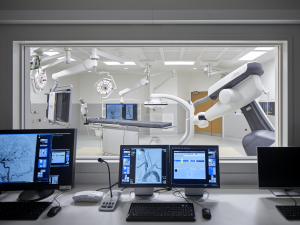
High-Definition AV & Debriefing Systems: In simulation suites and hybrid ORs, we integrate broadcast-grade video capture, multi-angle recording, and crystal-clear speech intelligibility.
Acoustic Isolation & Patient Privacy: Custom acoustic design ensures HIPAA compliance for patient discussions while isolating high-noise equipment from diagnostic and patient care areas.
Core Infrastructure Capabilities
Convergent Technologies Design Group Design Planning Framework
As a comprehensive technology firm, we unite all underlying facility infrastructure:
Healthcare Cabling & Wireless: Category 6A, fiber optic backbones, Distributed Antenna Systems (DAS), and hospital-grade Wi-Fi.
Acoustic & Vibration Control: Attenuating transformer and equipment vibration; designing acoustic privacy solutions for consultation rooms and patient suites.
Electronic Security & Access Control: Infant protection systems, card access for medication storage, and IP video surveillance integration.
Cross-Trained Accountability
The Convergent Technologies Design Group Difference
Traditional project execution relies on fragmented sub-consultants—one firm for medical equipment planning, another for audiovisual systems, and a third for telecommunications cabling. This divided approach often leads to scope gaps, conflicting drawings, and miscommunication on the job site.
Architectural Delivery Comparison
Project Dimension
Traditional Fragmented Approach
Convergent Technologies Design Group Design Approach
Consultant Structure
Multiple independent niche sub-consultants
Single multidisciplinary firm with cross-trained designers
Point of Contact
Separate managers for AV, Telecom, Security & Equipment
Single point of technical accountability for all systems
Design Coordination
Fragmented drawings compiled late in Design Development
Fully unified 3D BIM/Revit models built from Schematic Design
Scope Coverage
High risk of unassigned infrastructure gaps between trades
100% comprehensive coverage across physical & digital layers
Construction Impact
Frequent spatial clashes, RFI spikes, and change orders
Pre-construction clash elimination and predictable budget control
Our team operates differently. Our designers are cross-trained across all core low-voltage disciplines and equipment interface requirements. This multidisciplinary knowledge allows a single Convergent Technologies Design Group project leader to design, manage, and coordinate your complete technology ecosystem.
The result:
100% Unified Drawings: A single set of coordinated construction documents with zero discipline overlap or scope omissions.
Streamlined Coordination: Fewer sub-consultant meetings for architects and project managers.
Human-Centric Engineering: Technology designed around human usage rather than feature lists, guaranteeing intuition and reliability for clinical staff.
Proven Excellence Across Healthcare & Clinical Education
Convergent Technologies Design Group brings decades of credentialed experience to complex clinical, academic, and research environments:
Ruth Bader Ginsburg Hospital: Complete low-voltage and technology infrastructure design for state-of-the-art clinical care environments.
How does Convergent Technologies Design Group differ from a traditional medical equipment planner?
Traditional equipment planners focus strictly on clinical equipment selection and purchasing schedules. Our team bridges clinical equipment selection with the physical and digital infrastructure of the building. We ensure that every piece of medical hardware seamlessly interfaces with your structured cabling, audiovisual systems, acoustic isolation requirements, and architectural spatial envelopes.
At what project phase should equipment integration begin?
Integration planning should begin during Schematic Design. Involving our team early ensures that equipment footprints, headwall clearances, conduit pathways, and equipment room heat loads are properly calculated before architectural floor plans and structural drawings are frozen.
How do cross-trained designers reduce healthcare project costs?
When separate consultants design telecom, security, AV, and equipment layouts, scope overlap and miscommunication are common. Convergent Technologies Design Group’s cross-trained designers produce a single, fully coordinated set of drawings. This eliminates redundant conduit runs, avoids site clashes, and prevents costly contractor change orders during construction.
Schedule a Pre-Construction Drawing & BIM Review
Eliminate Spatial Clashes and Change Orders Before Groundbreaking
Are your current healthcare design drawings fully coordinated between medical equipment clearances, low-voltage cabling, and ceiling-mounted technology?
Schedule a complimentary Healthcare Technology & Equipment Clash-Detection Audit with Convergent Technologies Design Group’s senior healthcare integration principals. We will review your current schematic or design development drawings to identify potential infrastructure scope gaps, spatial conflicts, and sub-consultant coordination risks.